A Simpler Way to Work
Sul’sul’tun is easy to navigate, with minimal training needed, and a three-week setup that keeps your team moving.
Ease is the Innovation
For many Health Centres, technology has become part of the problem…

Documentation takes too long

Staff need ongoing training just to keep up

Workflows don’t match real work

Information is hard to use
Over time, this puts a real strain on your team…
Sul’sul’tun: Our New Modernized Solution
Sul’sul’tun is our newest platform, built to make documentation faster, easier, and more reliable for your team. It brings powerful smart tools that help staff quickly navigate and record clinical and service information.


Made for Indigenous Health Centres
Sul’sul’tun is designed with Indigenous Health Centres in mind, supporting the unique ways communities deliver care.
Simple, User-Friendly Design
The clean layout makes everyday tasks easier, helping staff work confidently and efficiently.
Low Maintenance
Easy to Customize
Affordable
Sul’sul’tun’s modern design reduces setup costs and ongoing maintenance, making advanced documentation features accessible and budget friendly.
Faster Setup, Less Work
Honouring Data Sovereignty
Bring Ease and Clarity to Your Health Centre
Schedule a demo and see how quickly you can get started.
Sul’sul’tun means Spindle Whorl in Hul'q'umi'num'
Just as the spindle whorl keeps individual strands/fibres together to create a strong strand of yarn, the Sul’sul’tun platform unites information in one place to create a powerful, accurate picture of the Nation and the health of a community.
FAQ
How is our data stored?
The Sul’sul’tun application stores and backs up all information securely in Canada, hosted on AWS, using encrypted, cloudbased infrastructure that meets the privacy expectations of Indigenous health organizations.
Personal and health information is protected through:
- Encryption in transit and at rest
- Role-based access controls
- Secure authentication
- Continuous monitoring and regular security reviews
Your organization maintains full control over who can access information within Sul’sul’tun.
Who owns the data entered into Sul’sul’tun?
The customer retains full ownership of their data in Sul’sul’tun. Sul’sul’tun strongly aligns with OCAP® and First Nations data sovereignty principles.
- The customer retains full ownership of the data and determines who uses it and how it is used.
- Mustimuhw’s role is to ensure its’ integrity, security, and that it is consistently available to the customer.
- If a customer discontinues use of Sul’sul’tun, an export of your data will be provided by Mustimuhw.
Sul’sul’tun is designed to support community driven decision making and uphold OCAP® aligned practices.
How long does implementation take, and what is required from our team?
Sul’sul’tun is intentionally simple to set up. Most organizations are fully onboarded in three weeks or less, with minimal disruption to daily operations. Implementation includes:
- A guided six step process that a lead(s) on your team can advance with our support
- Online staff orientation and training workshop
- Check in sessions to support customer driven setup and adoption
- Ongoing Help Desk and account management support
Because Sul’sul’tun is web-based, there is no IT infrastructure to install or maintain.
How is Sul’sul’tun Licensed?
Sul’sul’tun is licensed through a Service Level and License Agreement (SLA) that specifies the Terms of Service, the associated support services and the conditions of licensing. The Terms of Service portion of the SLA can be viewed here: Terms of Service
- Licensing is based on number of users
- Licenses are for annual terms
- Additional users can easily be added
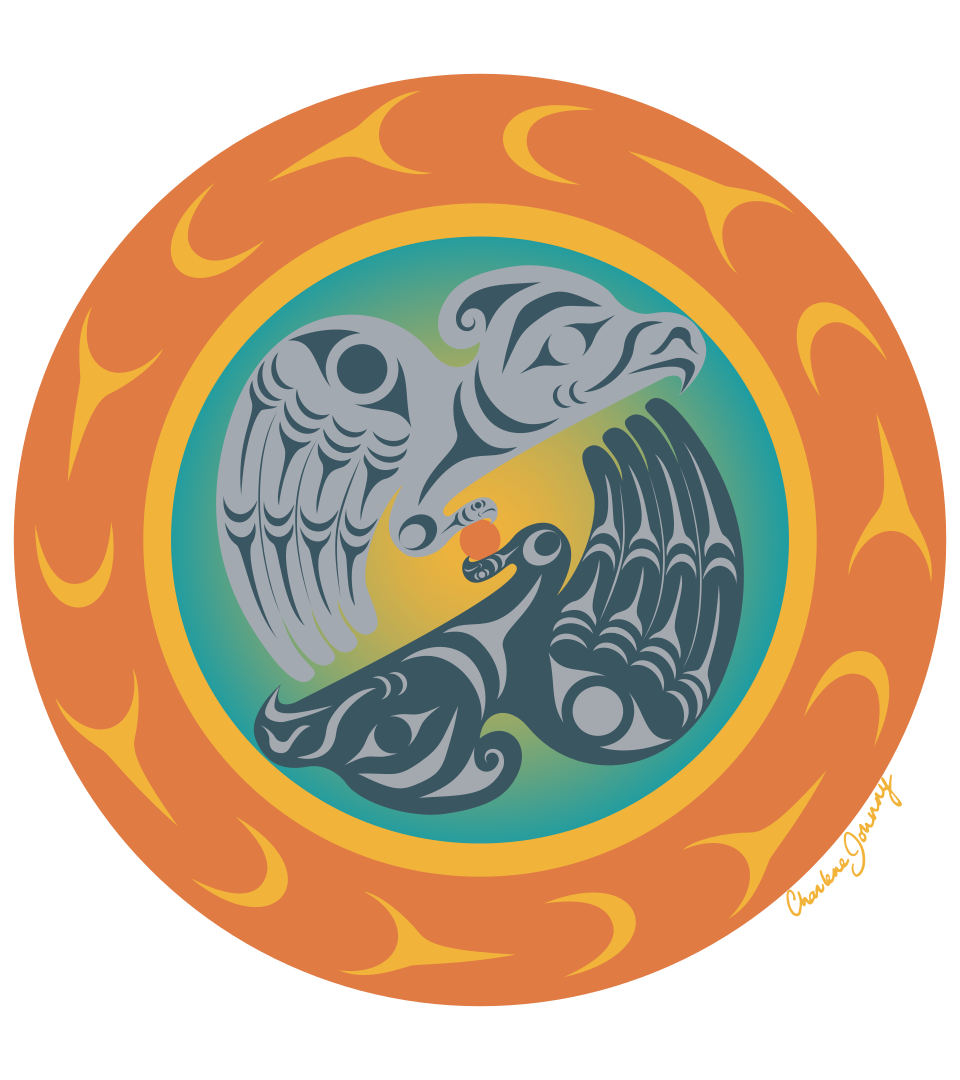
Sul’sul’tun S-hwu-hwa’-us
Two Thunderbird Spindle Whorl
The Sul’sul’tun S-hwu-hwa’-us features two Thunderbirds flying in opposite directions, creating a sense of balance, movement, and relationality. One may be interpreted as male and the other female, reflecting complementary roles and the importance of connection within family and community systems.
Within their legs are salmon heads, symbolizing life source, nourishment, and the responsibility to sustain future generations. A Coast Salish eye is embedded within the wing form, representing awareness, and the ability to see across time, honouring both ancestral knowledge and future pathways.
The composition is a circular form inspired by a spindle whorl, with repeating crescent and trigon elements that reinforce rhythm, continuity, and interconnected systems. Together, these elements speak to protection, guidance, and the weaving together of health, family, housing, and community care.
This piece reflects the broader purpose of the platform: carrying vision and story while supporting health, child and family wellbeing, and social and community services, including navigation of medical systems, housing, mental health, safety, and community care.
Thunderbird, who is associated with the Cowichan Tribes, feels especially fitting here as a symbol of strength, protection, and leadership, and I’m personally drawn to it through old Thunderbird songs and teachings.
Colour Scheme: 'Sunrise Wellness'
A warm orange paired with teal, evoking the meeting of first light and water. This palette feels hopeful, balanced, and welcoming, supporting a sense of renewal and care.
Charlene Johnny – 2026
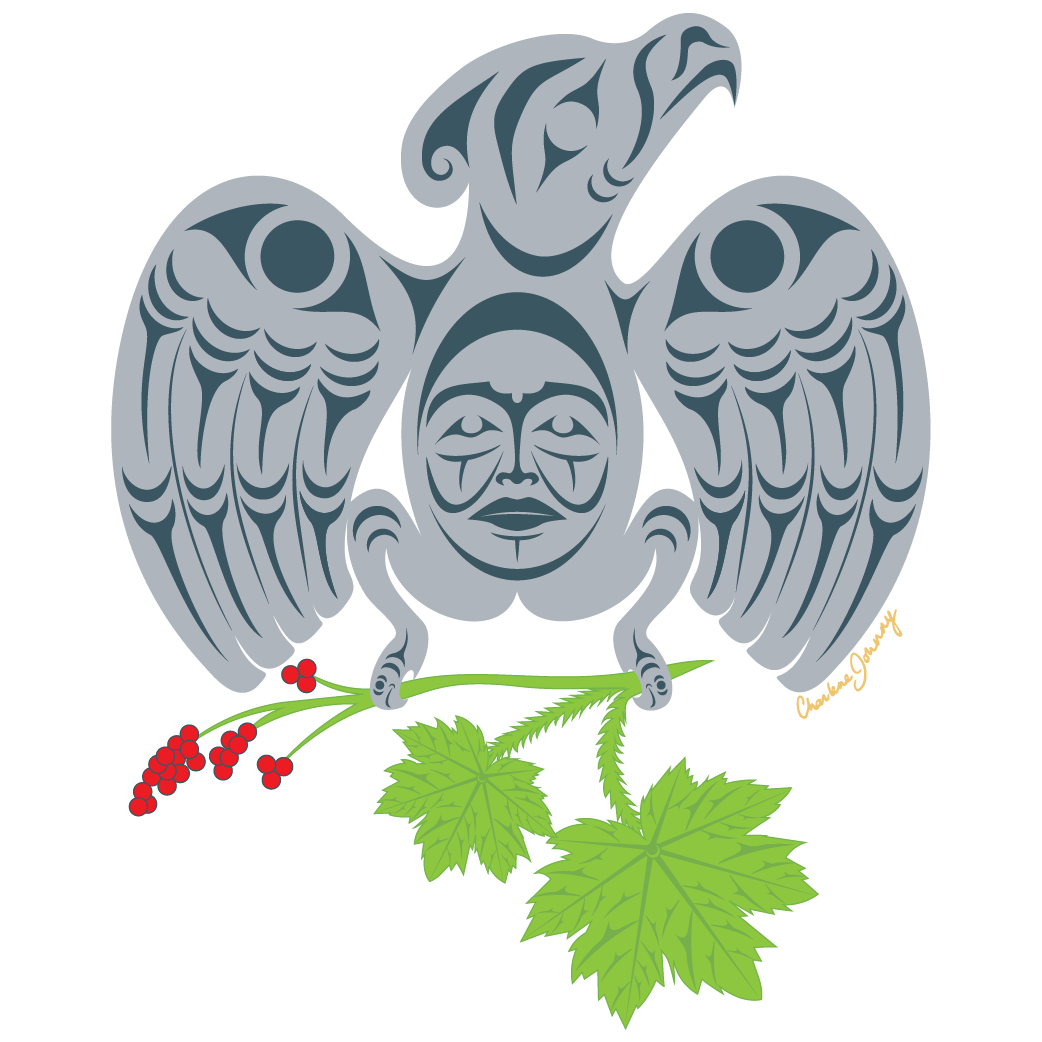
S-hwu-hwa’-us Qwa’pulhp
Thunderbird with Devil’s Club
The S-hwu-hwa'-us Qwa'pulhp piece is a focused adaptation of the foundational Sul'sul'tun S-hwu-hwa'-us piece. It centers a single Thunderbird with wings fully extended. The internal design elements remain consistent with the foundational piece, maintaining visual and cultural continuity. At the center of the Thunderbird's body, I have incorporated a face, referencing Coast Salish stories that feature humans having a connection and the ability to transform into supernatural beings. This presence can represent the ancestral protection and care we navigate as we navigate health care systems.
Held within the talons is devil's club, a plant known for its protective and healing properties. Across many coastal Nations, devil's club is one of the most important medicinal plants. It's used both physically and spiritually. The bark is used in medicines for respiratory health and blood sugar balance, as well as in topical ointments for skin conditions. It is covered in strong, sharp spines. You can't approach it casually; you have to be careful and respectful. It protects itself while still offering medicine. It only grows on the northwest coast, so it also represents place-based knowledge, ancestral relationships to land and access to local and natural medicine.
This piece carries the same core themes of protection, guidance, and relational care, making it well-suited as the primary visual anchor within the health application.
q'ul-lhanumutsun - orca
The individual is represented by a single orca surfacing in still water. This moment reflects presence, individuality, and a pause for breath. It speaks to where someone is in their own journey, held in a quiet and grounded space.
Charlene Johnny – 2026
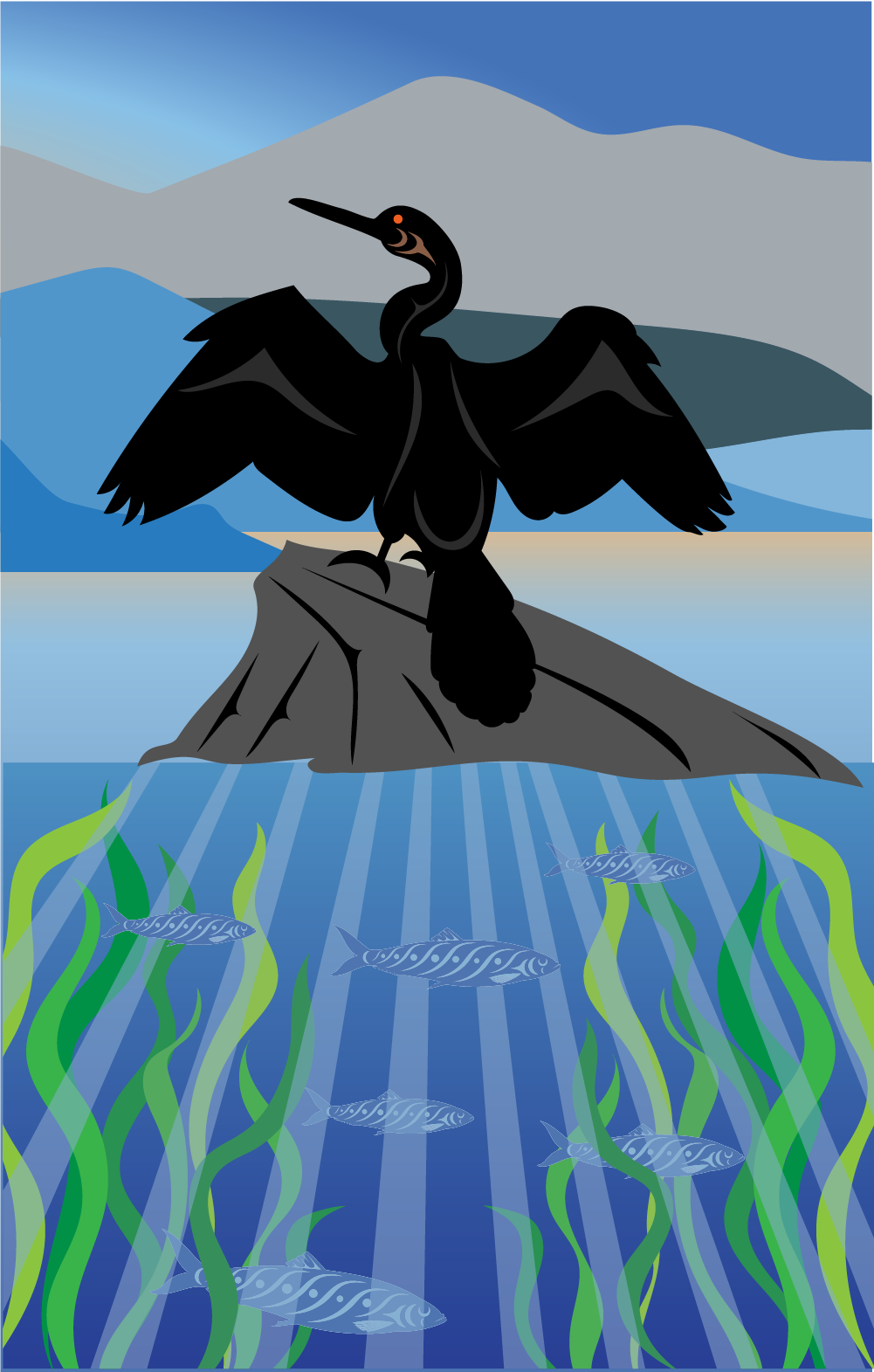
tsu'tun - helper
For the provider image, the perspective shifts to a view above and below the water's surface. A kelp forest rises from the ocean floor as herring move through it, while above, a cormorant prepares to dive or rests with its wings extended.
The underwater environment represents the deeper systems that sustain life, much like the care systems that support individuals and communities. The kelp forest offers shelter, nourishment, and balance within the ecosystem.
The cormorant represents the provider or helper. As a skilled diver, it moves between environments, gathering what is needed and returning with care and intention. It reflects adaptability, awareness, and the responsibility of supporting others.
Charlene Johnny – 2026
shhw'a'luqw'a - relations
The group is expressed through orcas swimming together, creating gentle movement across the water. This composition reflects connection, support, and shared experience, emphasizing the importance of moving together in relation.
Charlene Johnny – 2026